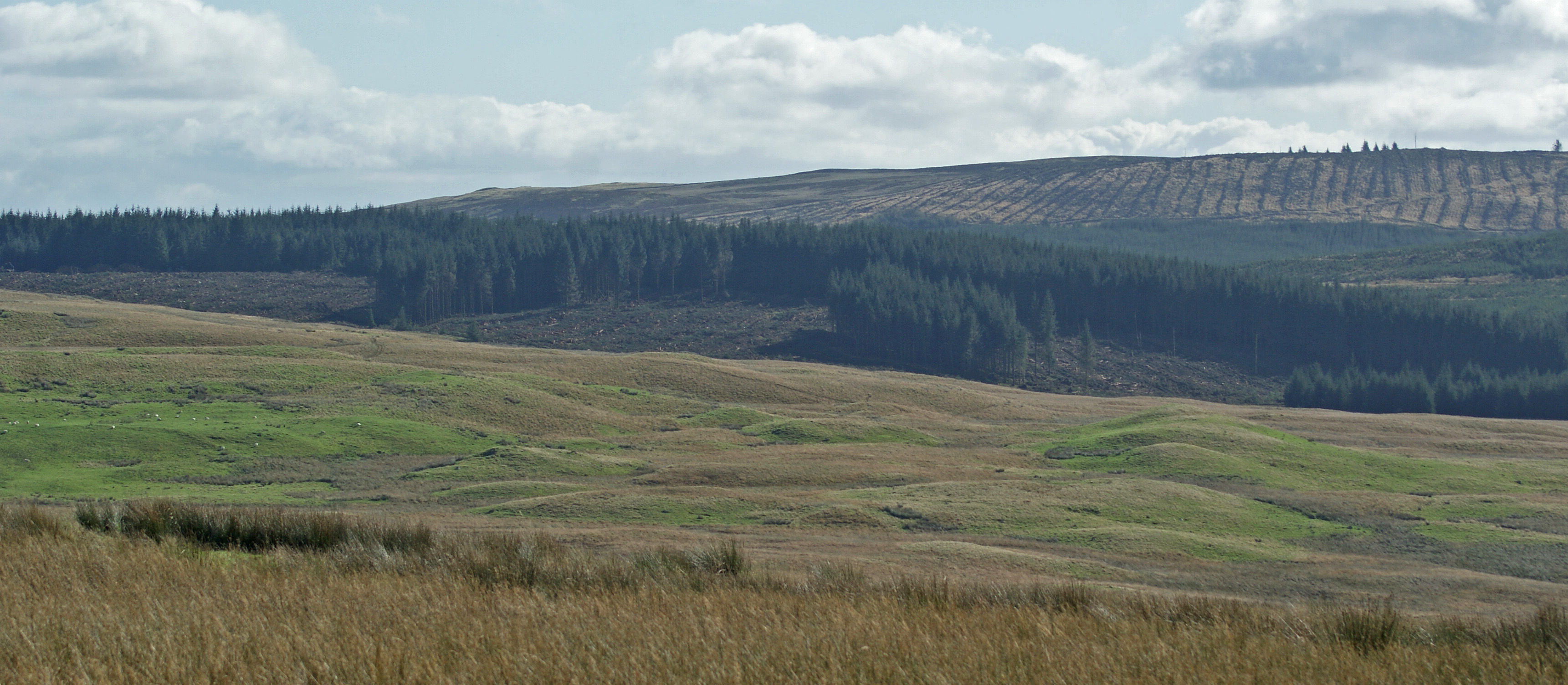
The woodland surrounding the Chayne is managed commercially. Big subsidies and tax breaks were being offered a few decades ago to anyone who wanted to plant trees, and as a result, one of the most devastating changes in land use that Britain has ever seen began to permanently destroy thousands of acres of the nation’s uplands. White hill and poor quality grazing land across the country was ploughed and stacked with evergreen tree species, and the consequences have been dire for many iconic bird species, including black grouse, red grouse and snipe.
Many of these commercial plantations were made up of scots pine and douglas fir, but Dumfries and Galloway was chosen for vast quantities of sitka spruce, a foreign species of tree that is not only aesthetically dire but offers almost nothing in the way of food or habitat for British wildlife. Planted in such thick concentration, these spruces have shaded a quarter of the entire land area of Dumfries and Galloway, smothering thousands of acres of peat bog and heather moorland into non existence. Scots pine, norway spruce and douglas fir all have some merit in their ability to provide wildlife with food and shelter, but sitka spruce is little more than a tall and unpleasant weed with nothing to say in its favour other than the fact that it grows quickly. It creates thick and impenetrable stands which act as physical barriers across the landscape. I don’t believe that anyone could walk through sitkas and claim that the experience was any more than deeply unpleasant, painful and boring.
Thanks to research carried out in areas where the chief crop species of tree is scots pine or douglas fir, scientists have recently discovered that managing woodland sensitively can be an advantage to black grouse. Studies in Perthshire and North Wales showed that harvesting trees on rotation created a moderate quality habitat for the birds, and breaking up the “hard” woodland edge into a series of bays offered birds shelter and security from predators. There’s no doubt that some forests can be made to work for black grouse, but it depends hugely on what the forest is made up of. “Scalloping” is great in scots pine forests, where the aim is to create a broad moorland margin of trees at various stages, and scalloped larches adjacent to wet bogs is ideal for greyhens in the run up to the breeding season, but the management technique is not what is good about these habitats. It is the species that is being managed.
When the results of these research studies were applied to forests made up of sitka spruce, commercial foresters worked themselves into a state of great excitement. Finally they believed that they could morally justify their destruction of quality moorland habitats by building black grouse into their man made jungles, quite irrespective of the fact that sitka trees above the age of four or five years are totally incapable of supporting the birds. As is currently taking place on the boundary of the Chayne, attempts are being made to manage sitka spruce for black grouse by “scalloping” forest edges and by felling on rotation. They might as well be trying to build black grouse habitat out of plasticine and fox shit. If you don’t use tree species that are amenable to black grouse, it doesn’t matter whether they are “scalloped” or harvested on rotation. The birds won’t take to them unless there is either a preponderance of larches, scots pines or trees which allow some light in to the undergrowth.
In Galloway, there is no such thing as a small plantation. The Chayne is surrounded by a continuous mass of more than eight thousand acres of sitka spruce trees. No wonder black grouse are in dire straits when they have been boxed in by a foreign tree species that is useful only to provide a perch for the occasional goshawk. Scalloping the edges of sitka plantations may be a publicity coup for some ecologist, but if commercial forest managers would concentrate on using environmentally beneficial tree species in their plantations, I wouldn’t be living in a county with less than two hundred lekking blackcock.
And if they really wanted to help black grouse, they would be shooting foxes and trapping crows. But what do I know?


 Bog Myrtle & Peat
Leave a comment