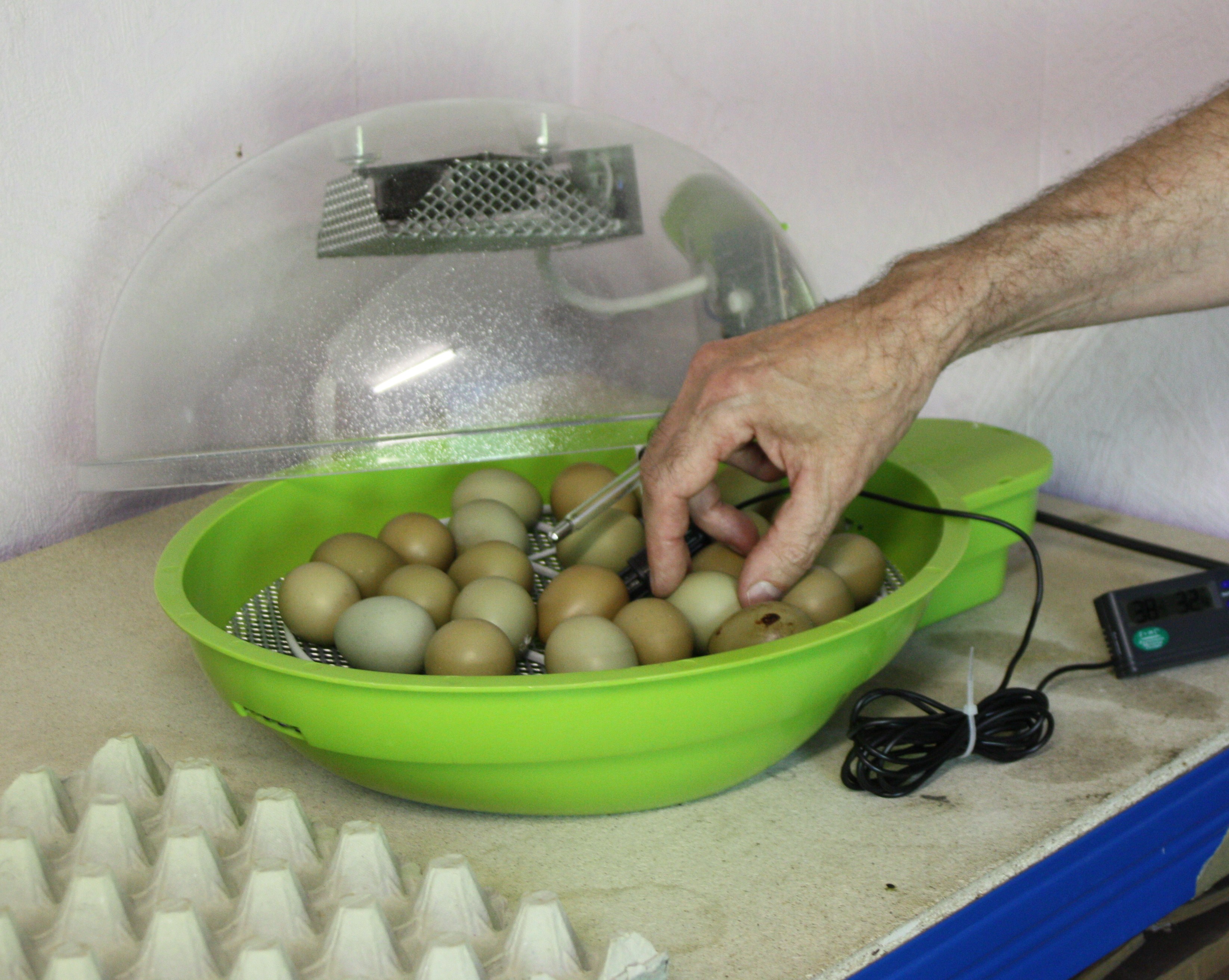
Having come across two dozen pheasant eggs on Friday, the time came yesterday to put them into the incubator. I may well look like a fool for admitting it, but I had no idea that eggs retain their fertility and hatching potential for up to three weeks after they are laid. I had always thought that eggs were part of a continuous process of development which couldn’t be delayed or interrupted, and it had never occurred to me that they could lie dormant until the process of incubation begins. I suppose that it makes sense when you remember that birds lay single eggs day after day and then hatch their chicks all at once, but it just never occurred to me to think about it.
The pheasant eggs have been placed inside a Fiem 24 fully automatic incubator, with a moveable turning cradle which will gradually rotate the eggs to simulate the movement of a broody mother. The base of the Fiem has a reservoir which can be filled with water to keep the inside of the of the capsule at a constant rate of humidity, and conditions are constantly monitored by a high-tech digital hygrothermometer. We will candle the eggs in a few days to find out which are fertile and which are not, and the process can start to pick up pace.
As mentioned in a previous post, this project is being sponsored by Solway Feeders. They are being kind enough to support my steep learning curve, and I will be documenting everything I do for them on their website, including details of all accessories, kit and equipment I use. I include updates on this blog because I find it interesting, and it is quite relevant to my project on the Chayne. After all, any chicks which hatch will be released on the hill in August to supplement my scant population of wild pheasants.

 Bog Myrtle & Peat
Leave a comment