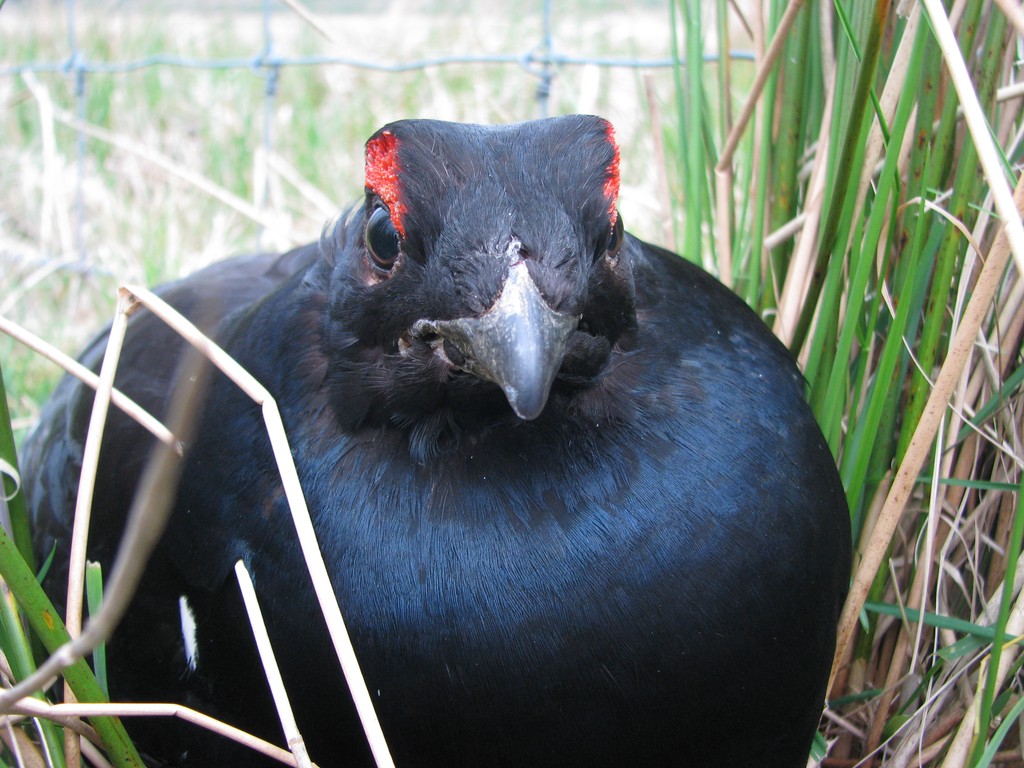
Black grouse are some of the fastest British gamebirds. Their deceptively large size and bulky shape might make you think that these birds are the equivalent of a lumbering Avro Lancaster on the wing, but in truth, they can hit speeds of over 70mph, and they could probably fly even faster downwind if they didn’t have a long tail which gets easily tangled by a draft from behind. A blackcock on the wing is an observant beast, constantly stretching his long neck up to keep tabs on what is happening around him, but high speed brings with it high risks.
Whistling through the air at the same speed as a car on the motorway, black grouse are vulnerable to collisions, particularly with fences and unmarked telegraph wires. Thankfully, Galloway’s red deer population is centred away from the Chayne and there is no real need for tall stretches of high tensile deer fencing on my patch, but birds do hit lower stock fences, particularly when they are stressed or if the fence has been recently erected and is still unfamiliar. A local blackcock was found dead at the foot of some rylock sheep netting just a few months before I began my project, and nasty collisions are by no means a rarity.
Up in the Angus Glens, deer fences are far more common, and they can be cited as a worrying cause of mortality amongst adult black grouse. Mike Groves, a fellow moorland enthusiast, spotted a blackcock hit a fence at high speed recently, and although he found that the bird had survived the collision, it was very much the worse for wear. He sent me this picture (above), which is a sad spectacle.
A great deal of money has been spent on removing old deer fences in high risk areas to minimise black grouse, red grouse and capercaillie collisions, and many miles of fence have been marked with high visibility netting to warn birds that an impassible object lies before them. When I fenced off an area of moorland on the Chayne last year, I marked the wires with shreds of ripped up clothing, and mercifully that seems to have done the trick.
It might seem that black grouse already have enough to contend with without having to worry about hitting fences, but the problem is real and dangerous. At the same time, it needs to be viewed in context. You could mark every fence in the country and still see a decline in black grouse numbers, because this problem is one of many.

 Bog Myrtle & Peat
Leave a comment