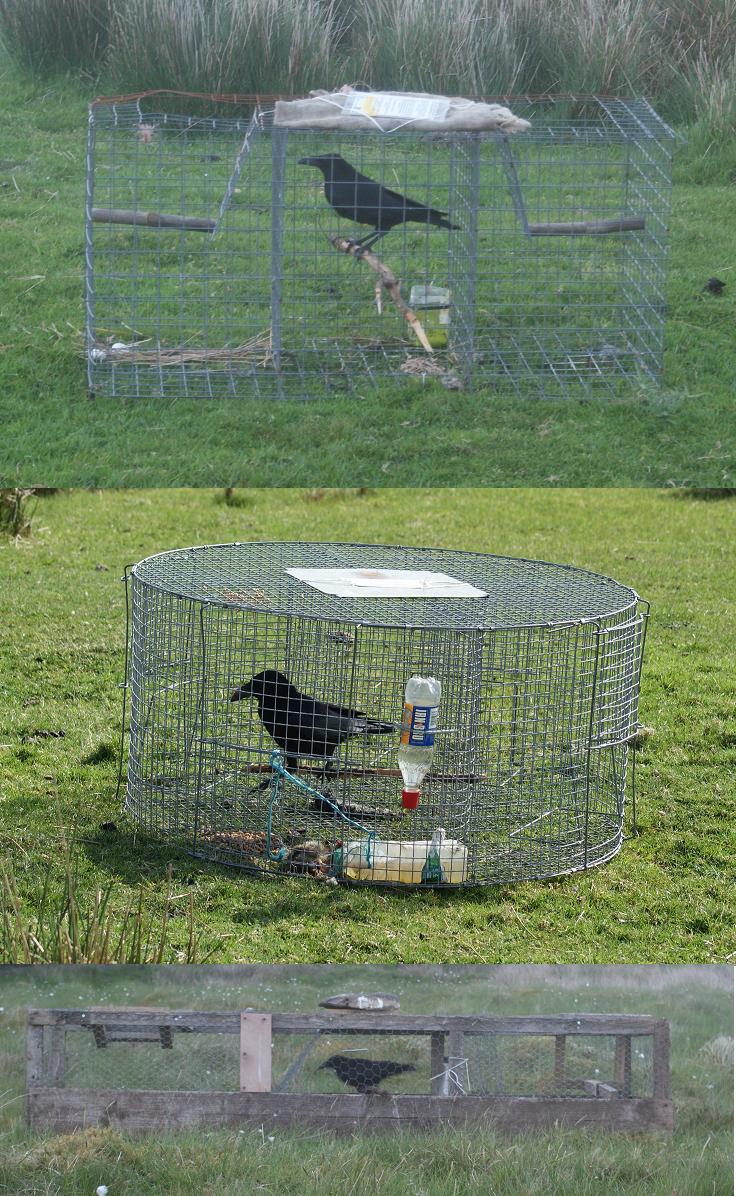
With larsen trapping drawing to a seasonal close after seven weeks of operation, it’s worth pointing out that this year has been a really steep learning curve for me. Hill crows must be the wiliest devils in the animal kingdom, and although I have taken more than a dozen birds out this year, I must have missed at least the same number again.
My problems stemmed from the fact that I was working more or less blind. I had three traps, all of a different design, and I had no idea where to put them. Bit by bit, I worked out some prime locations, but at the risk of being a bad workman blaming his tools, I think that the traps themselves have alot to answer for. There is an increasing variety of different larsen traps on the market, and having found what doesn’t work in my selection of three, I can now look for a trap that will do the job.
The first problem is visibility in the trap. There is no point in keeping a call bird in a trap where it is not in full view. Although it is a legal requirement to provide some shelter from wind and rain, the call bird needs to be seen from a long way away, and my own attempts at converting an old hen run into a trap (pictured bottom) fell at the first hurdle. High side boards meant that the callbird needed to sit up on his perch in order to be seen, but in the face of prevailing winds, he seldom bothered. The trap did catch birds, but many must have failed to spot it altogether, or were put off by the illusion of enclosure created by using a low, broad trap with wooden sides.
Top entry and side entry traps are suitable for different circumstances, and without a doubt I had more success with my side entry trap. Hill crows seem to like walking around a trap before springing it, and my Solway Multi Larsen (middle) fitted the bill neatly, taking nine crows from a single field over the past few weeks. The disadvantage was that, in order to find a nice open space to use the trap, I was forced to site it in lambing fields, where it was bumped and accidentally sprung by passing sheep and lambs on more than one occassion.
My top entry trap (top) failed to catch any crows whatsoever, and I can wholeheartedly say that this trap is one of the worst I have ever seen. The mesh is so wide (two and a half inch square) that crows reached in from the outside and pulled out food for the call bird without ever considering the possibility of entering from the top. Thanks to a helpful suggestion from a reader of this blog, I now know that I should have put a turf on the roof of the trap so that crows could have landed on the raised grass and dropped in from there. It is perhaps a little late to try this now, but it will be a must for next season.
From what I have learned this year, I can see that a secure side entry trap with a robust trigger system would be ideal for the Chayne, and I am currently looking around to see where I might find such a thing. Having missed crows through a variety of silly mistakes and ignorance this year, I will see to it that next year I am not only better informed, but that I am also fully equipped with the perfect traps for the property.

 Bog Myrtle & Peat
Leave a comment