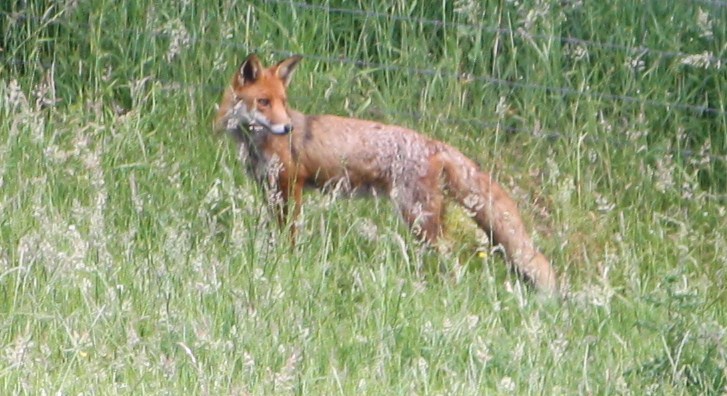
After almost eighteen months since beginning this blog, and two years since beginning my project on the Chayne, I have come at last to the inevitable subject of snaring. Having snared foxes on a low ground shoot almost five years ago, I knew some bits and pieces about the technicalities of setting and maintaining snares, but applying knowledge gained in deciduous woodland to the open moors seemed too problematic and full of risk.
Snares have attracted a huge amount of publicity over the past few months in Scotland, and several animal rights groups are rabid in their denunciation of these simple traps. In truth, I was reluctant to make a start with snaring because I knew that snares are surrounded by screeds of complex legislation, and that contravening even a single word of the law was and remains out of the question for my project.
There is no doubt that, used carelessly, snares can cause damage and harm to wildlife and stock, but having spoken to a variety of keepers and farmers since beginning my project, I began to see that they are a necessary tool for someone in my position. There is no reason why snares can’t be used sensibly and efficiently, and having sat a snaring course and exam yesterday under the watchful eye of the GWCT, I feel better equipped than ever to make a start with this fascinating and complex practice.
After a lengthy discussion on the WANE 2011 (Scotland) bill, which came within a whisker of banning snares altogether earlier this year, the students at the snaring course were asked to set snares, then sat a short multiple choice exam on the rights and wrongs of snaring. The only difficult questions were “How far should the stop be set from the eye of a fox snare?” (nine inches) and “What is the minimum breaking strain of snare wire?” (204Kg), and the day felt more like an effort to pool experience and information on efficient snaring practice.
We were asked to consider setting snares higher than we would usually do to avoid badgers, and were given an introduction to middens and stink pits. It was familiar territory for many of the keepers present, but I picked up some vital bits and pieces which may help to tip the balance up on the Chayne. While it will be a few months before I make a start with snaring, I now feel confident that I could operate a fox snare legally and humanely.
It is now a legal requirement that everyone using snares should have taken this course, and given that it only cost £40, I didn’t feel too hard done by. In fact, I would encourage anyone with an interest in the countryside to consider taking the course. Whatever you think of the practice in moral terms, fox snaring is an art form which takes years to master. At a time when traditional country practices are falling away day by day, it surely does no harm to learn something new and keep some fascinating fieldcraft alive.
I left the course with the impression that, like larsen traps, snares are not inherently cruel, but that they can be made so by thoughtlessness and inattention.
It’s also fair to assume that snares are no more cruel than the poisons used to kill thousands of rats and mice every year. In a commercial environment, man will apparently stop at nothing in his attempts to kill rodents, so it seems a little imbalanced that snares attract more negative press than widely used bromadiolone based rat poisons, which cause distressing internal haemorraging. It is not for me to reason why simple fox snares should be taboo while pesky rodents can be bumped off with a cocktail of lethal drugs, but I suppose that accepting the irrational will of the majority is part and parcel of social democracy.
It could be that, through my current job, I can help to design and test a new fox snare which will be legal for use under the new WANE Bill, along with various means of anchoring snares and preventing them from tangling. Watch this space…

 Bog Myrtle & Peat
Leave a comment