I frequently write on this blog that the Chayne is run down, neglected and in poor condition. On the whole, these are probably exaggerations. Like so many farms across the country’s uplands, the Chayne suffers from a general lack of financial investment, and while it could stand to be greatly improved, the land itself is more than capable of producing quality crops of lambs year after year.
The reason I refer to the farm as being “in poor condition” is because it is far away from how I would like it to be. One day, I plan to return the farm to its condition sometime in the late 1920s, when gamebirds abounded and the farm was not only performing at its best, but pride was also taken in its appearence. Nowadays, one of the main features of the Chayne is that it is home to collapsed drainage systems and rotten drystone walls. The former is an advantage to snipe, but the latter serves only to give the place a barren and neglected feel.
The Chayne has thirteen miles of standard five foot Galloway dyke, surrounding and criss-crossing it, but less than seven of those miles could be described as functional. The rest are little more than tracks of abandoned stone in the rushes. They may well provide wheatears with cracking nest sites, but these great little birds must suffer a proportionate loss off eggs and chicks from the inevitable army of weasels and stoats which haunt the rocky stacks.
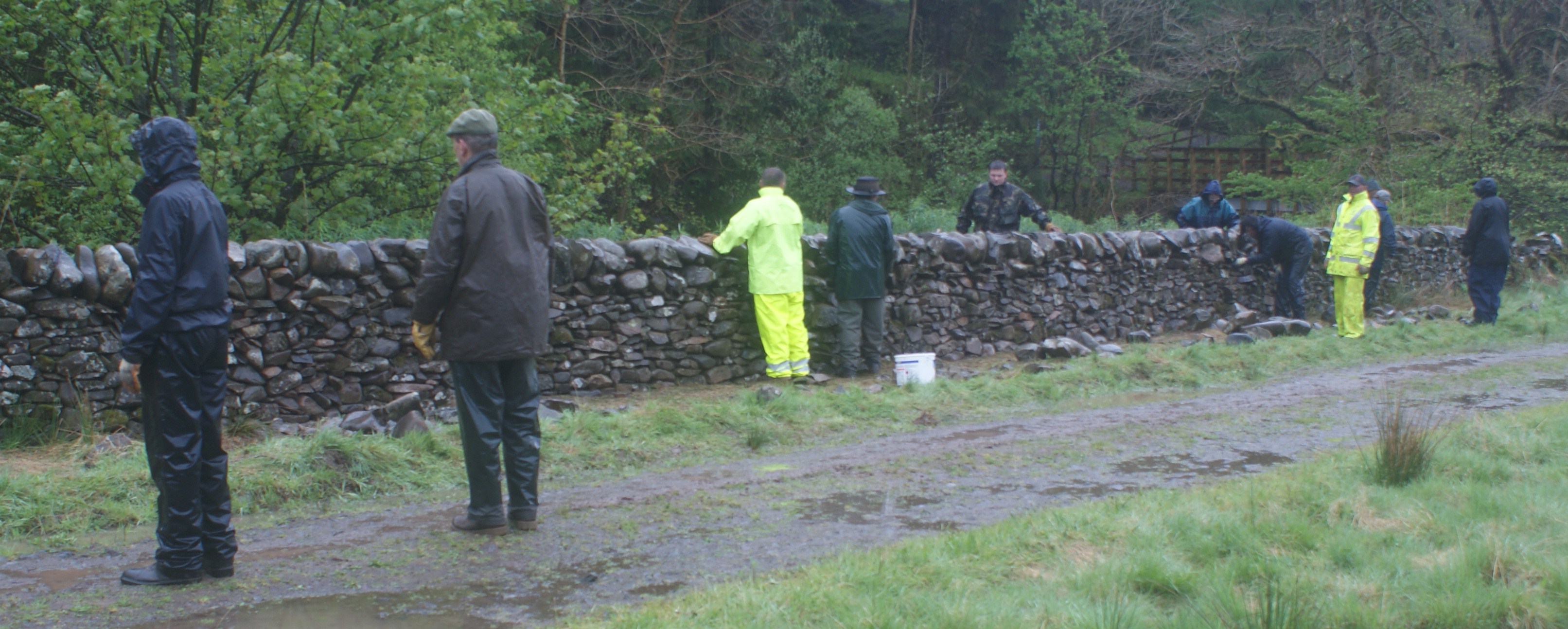
With a view to repairing some of the farm’s dykes, I took a course last weekend which taught me the basics of drystone dyking. Run by the Drystone Walling Association of Scotland, the course put fifteen novice dykers through their paces, demonstrating how to build a standard four foot double wall from the foundations up.
Despite my initial reservations, it was actually very fun. Looking at boulders as part of a puzzle was a novel experience, and it was extremely satisfying to see how even the smallest pebble could fit it and strengthen carefully established ties between stones so that a real wall could begin to take shape. After three hours, I had built a short section of dyke to a height of two feet, and the students on either side had done likewise. We built in “straps”, packed in the “hearting”, fussed over the “batter”, and laid on the “covers”. The lingo seemed irrelevant as I started to see how stones could fit together, being pinned and wedged into place against others to make a solid, durable obstacle.
By Sunday, the fifty metre section of wall was almost complete, and after the complex process of “coping” had been carried out, we were all pretty proud of what we had achieved. A good dyker can build four metres of drystone wall in a day, and although we were all still novices, our shared effort certainly looked the part. It is certainly a slow process, but the results are worth it.
A dyke can last (with some maintenance) for thousands of years, while a fence needs to be replaced every thirty or forty. A dyke is visible to birds, preventing nasty collisions which are associated with high tensile deer fences, as well as giving shelter and nest sites to a variety of wild animals and plants.
Most of all, a dyke looks better. The very fact that it takes such a long time to build shows that somebody cares about the land, and that it is being used for more than just financial gain. Nowadays, it is so easy just to fling up a rylock fence that the sight of a new dyke really says something about how a landowner views and treats his property. In the absence of grants, it was always going to be impossible for me to pay a dyker £15 an hour to refurbish the many miles of dyke on the farm, so I may as well have a bash at doing it myself.
I may be naive to think that farmland needs any more than just to be worked, but it looks to me that, at the moment, the Chayne needs to be treated to some care and attention.

 Bog Myrtle & Peat
Leave a comment