The further away we move from the illusion of death and lifeleness which was so apparent in December and January, the more interesting things become. The seasonal aggression and territorial behaviour of crows is playing against them as, day by day, they vanish into my larsen traps, while lapwings, curlews and oystercatchers are establishing their breeding grounds with an audible energy. Everything is vigorous, lively and fascinating on the moor, and the last week has taken it all up another gear. Birds are changing their behaviour to become more conspicuous than at any other time, and my nightly lamping trips are now played out to the fantastic backdrop of constantly drumming snipe.
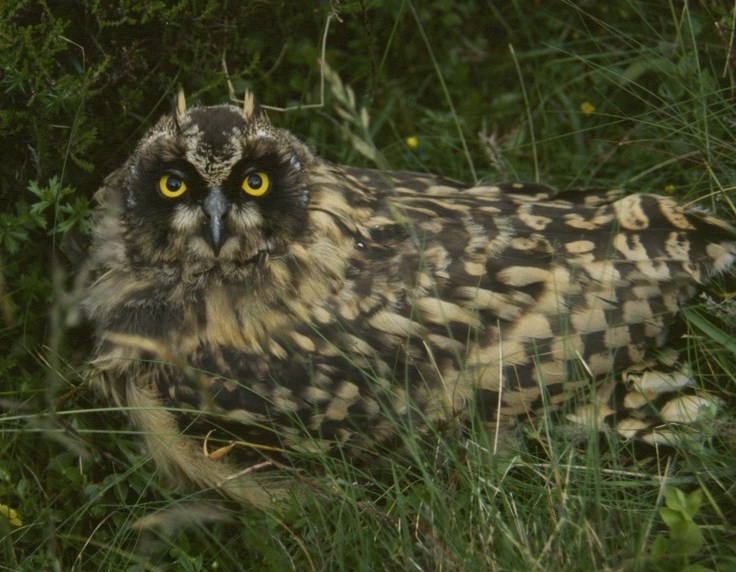
Walking through the heather yesterday morning, I disturbed a large pale shape from the undergrowth infront of me. My first reaction was that it was a juvenile hen harrier, but the loping wingbeat and honey-barred feathers pointed beyond all doubt to the fact that I was looking at a short eared owl. I was absolutely delighted. I have only ever seen one short eared owl on the Chayne, at that was almost fourteen months ago. They are the most beautiful of our birds of prey, and as it cruised further on to the hill and landed about a quarter of a mile away, I was furious for having left my camera at home. I did notice that it was carrying something as it flew, and I decided to have a look and see what it had been doing in the heather when I disturbed it.
My heart sank to find a red grouse feather. And then another. A large patch of feathers swirled in the long grass, and part of the carcase was lying on a mound of moss. The owl had been feeding on one of the pair of birds which I have been keeping an eye on since late Autumn, and had Photographed For This Blog In November. I had held high hopes for that pair, and the glory of seeing a short eared owl vanished instantly.
Handling the remains, I found that the flesh was cold and that the sinews were stiff. My first reaction was to blame the owl, but it seemed unlikely that it had been responsible, given that it was feeding a kill which seemed to be hours old. There was no doubt that it had flown away with part of the grouse, but I was increasingly unsure who was responsible for the death. After a brief exchange of emails with Mike Groves, an expert on short eared owls from Angus, I can now fairly well dismiss charges against the owl. As Mike points out, short eared owls weigh considerably less than red grouse, and they prefer tackling easier and less challenging prey, like voles and small mammals.
The fact still remained that this owl was feeding on a grouse, and the best explanation has to be that it came across the carcase after it had been killed by a different bird. It seems unlikely that short eared owls offer much of a problem to grouse apart from the possibility of stealing the occasional chick, and I will have to look elsewhere for an explanation for this frustrating loss. There was so little left of the grouse remains that I couldn’t tell if it was the cock or the hen who had bought it, but if it was the cock, there is still some hope, since the hen may be sitting tight on eggs elsewhere…

 Bog Myrtle & Peat
Leave a comment