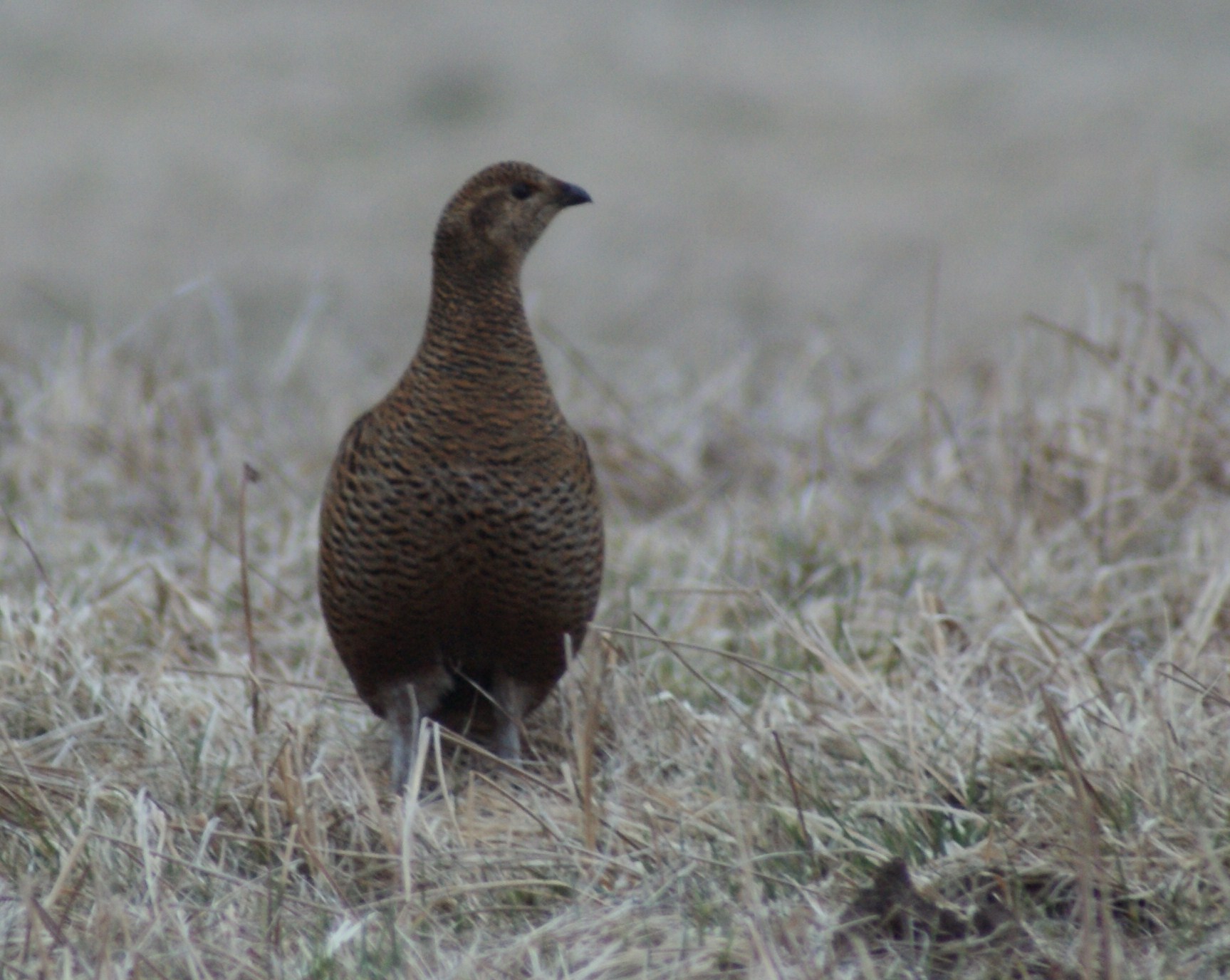
County Durham is probably one of the best places in the entire country to see black grouse. While some estates in the highlands of Scotland may have more birds, the blackcock and greyhens of these wide open English hillsides are so conspicuous that they are reliable enough to travel long distances on a tight budget to see them. Staying in Northumberland last night, I couldn’t miss the chance to see how the leks were going in Weardale and Teesdale, and I set off a 5am this morning on the half hour drive to black grouse nirvana.
I had a vague idea of where the main leks where, but thinking it would be more fun to find my own, I began to stop the car and wind down the window every half or quarter mile to have a listen for the familiar bubbling sound. A wind rumbled at the open window, making it hard to hear anything for certain, but snatches of melodious cooing carried through now and again, and I knew I was close. A line of eight feeding greyhens appeared through some blow grass to peer at me, and single blackcock wandered idly around the roadsides, but the fabled “big leks” were proving hard to find.
Four or five large packs of greyhens emerged as the morning brightened, and two blackcock lekked together in the inbye field of an abandoned cottage. In an hour, I had seen more than sixty birds, and was having the time of my life. Anyone who has even the faintest reservation about the benefits to conservation brought about by shooting should drive up through Langdon Beck on a March or April morning. Over the course of an hour, I saw red grouse, black grouse, snipe, woodcock, pheasant, grey partridge, red legged partridge, golden plover, hare and roe deer – very nearly every single British game species living within a couple of square miles.
As well as sporting birds, ludicrous numbers of lapwings, curlews and oystercatchers spilled over the block-built dykes, and it occurred to me after a little while there had been the constant sound of birdsong since my arrival. Snipe drumming, lapwings screeching and blackcock bubbling made an unrelenting throb of sound which could never be replicated anywhere other than as a result of quality moorland management and sensible gamekeeping.
Satisfied without seeing any of the “big leks”, I turned for home at eight o’ clock, pondering on different ways of recreating elements of Teesdale on the Chayne. I hardly noticed a collection of 13 blackcock lekking furiously within sight of the road…

 Bog Myrtle & Peat
Leave a comment