One of many things I have been working on as part of my project to learn more about black grouse is to find out about lekking displays. Having access to a single lekking bird has been a great opportunity to carry out some basic experiments, and I have been determined to find out what makes these displays happen. Usually, the single bird is content to act out typical behaviour, wandering around with his head low to the ground, bubbling and cooing and stopping occasionally to sneeze violently.
When pheasants pass nearby, he becomes more proactive and begins to behave more like a blackcock in the presence of others. Yaffling and striding around with great pomp and circumstance, he locks horns with pheasants without a backward glance. However, unless there is a direct reason for him to scream and attack, he is relatively placid and carries out his lekking display with a degree of satisfied patience.
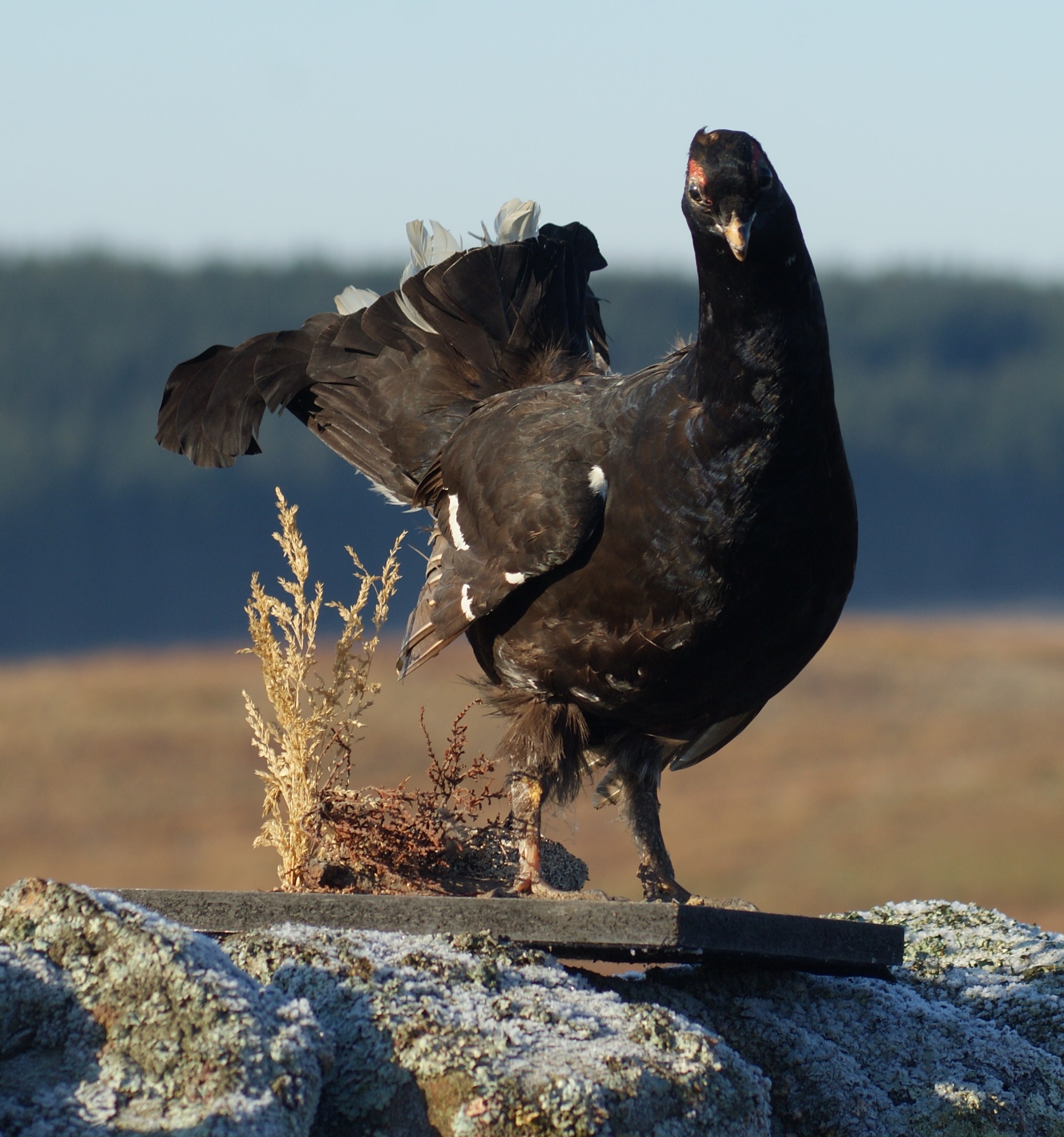
In order to find out what it was that made him take his displays up a gear, I borrowed a stuffed blackcock from a friend. It was shot on a farm to the west of the Chayne almost forty years ago and has become quite tatty, but I hoped that it would serve my purposes well. Yesterday morning, I took advantage of the fog to creep in close to where the blackcock was lekking and set up the stuffed bird within a few yards. An hour later, the fog cleared, and I watched as the blackcock walked within feet of the impostor without batting an eyelid. I was certain that the stuffed bird would do the business and bring on an attack, but it seemed like the blackcock couldn’t care less.
Within half an hour, the blackcock took to the sky with a clatter of black and white wings, coming to rest a few hundred yards away in the hayfield behind the house. He continued lekking as soon as he landed, so I dashed up the hill, retreived the stuffed bird and followed close behind him. The blackcock was now lekking beside an old wall, and it gave me the opportunity to crawl to within a few feet of him. I took a sheet of white paper and waved it suddenly over the wall, then replaced it with the stuffed bird as if to imitate its black and white flapping arrival. I then began to wobble the stuffed bird back and forth along the top of the wall like a puppet from a punch and judy show.
The reaction was not long in coming. An almighty scream sounded from the blackcock, and just as I raised my head to see what was happening, he launched into the air on a flutter jump. He landed within a few feet, but must have seen me, as he stared with sudden suspicion at where my head had been. Unsatisfied, he raged and yammered back and forth as I continued to bob the stuffed bird back and forth along the wall. Finally, he did a large flutter jump and flew into full sight, where I felt suddenly embarrassed at being caught making a mockery of him. He eyed me as if to say “I knew it!”, then soared off into the distance.
It’s too early to be drawing pseudo-scientific conclusions from yesterday morning’s experiment, but it seems like movement is a really important signal for black grouse in recognising a rival or a competitor. Confronted with a bird which didn’t move made no difference to him, but the same bird being wobbled back and forth created a spark of furious recognition. Sound is obviously very important to blackcock when they are lekking, and I am working on a way of recreating the bubbling sound by blowing into my hands and rolling my tongue so that I can do some more experiments.
However, now that he is approaching the time when mating might take place, I will have to draw them to a close until May or June. It’d be silly to wind him up if he’s busy trying to produce the next generation of black grouse on the Chayne.


 Bog Myrtle & Peat
Leave a comment