Any regular readers of this blog will know that its subject matter sways back and forth with no discernible structure or pattern. I make no apology for this, but should explain one particular absence over the past few months. Sixteen weeks have passed since I last saw my favourite blackcock, and it had become fairly obvious that the poor blighter had gone to a grisly end. I didn’t like to admit it to myself, so I was avoiding the subject altogether in my blog entries.
The last time I saw him, he burst out of cover from an unexpected spot and flew far out onto the moor where I have never seen him before. I assumed that it was as the result of a change in seasons and hoped that his new situation would suit him as nicely as the inbye fields around the farm had done during the summer. As the weeks went by, I gave up hope of ever seeing him again. Several explanations came to mind to explain how he had met his grisly end, but the main issue was that he was gone and that there would be no more lekking displays on the farm in 2011.
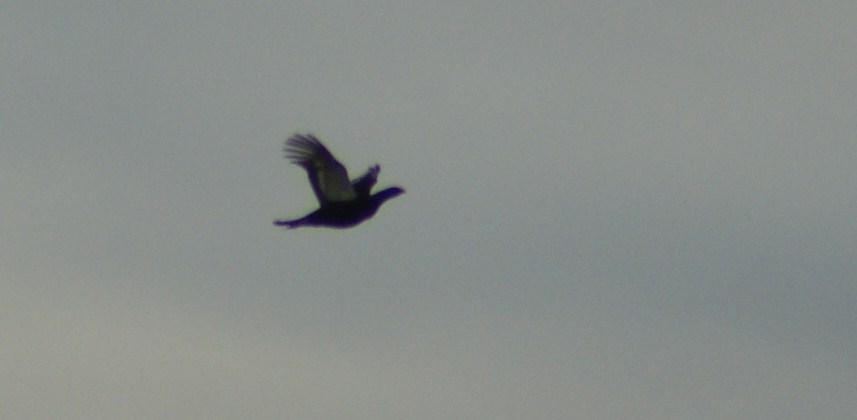
Driving up to the farm today through stripes of dirty snow, I pulled through the main gate and got out to close it behind me. Three hundreds yards ahead amongst a patch of thick heather, a distant shape rose vertically upwards like a cross between a teal and a cock pheasant. As it gained height, I recognised a very distinctive wingbeat and just managed to get my camera up in time to take three photographs as my favourite blackcock soared directly overhead and up onto the hill above.
After having made my vow to crush vermin in 2011, it looks like now I have a real reason to go all out in the war against foxes, crows and stoats. Despite the death of a greyhen towards the back of the farm, which I discovered on hogmanay, the presence of this blackcock is a tremendous boost. Blackcock tend not to disperse for breeding purposes, but they do call in greyhens, who are hardwired to search for new breeding grounds in the springtime. The fact that he has survived this long gives me great hope that he might manage a little longer to lek in March and pull in new greyhens from the surrounding area. It’s still a matter of crossing fingers and touching wood at all times, but it could be a good year on the hill…

 Bog Myrtle & Peat
Leave a comment