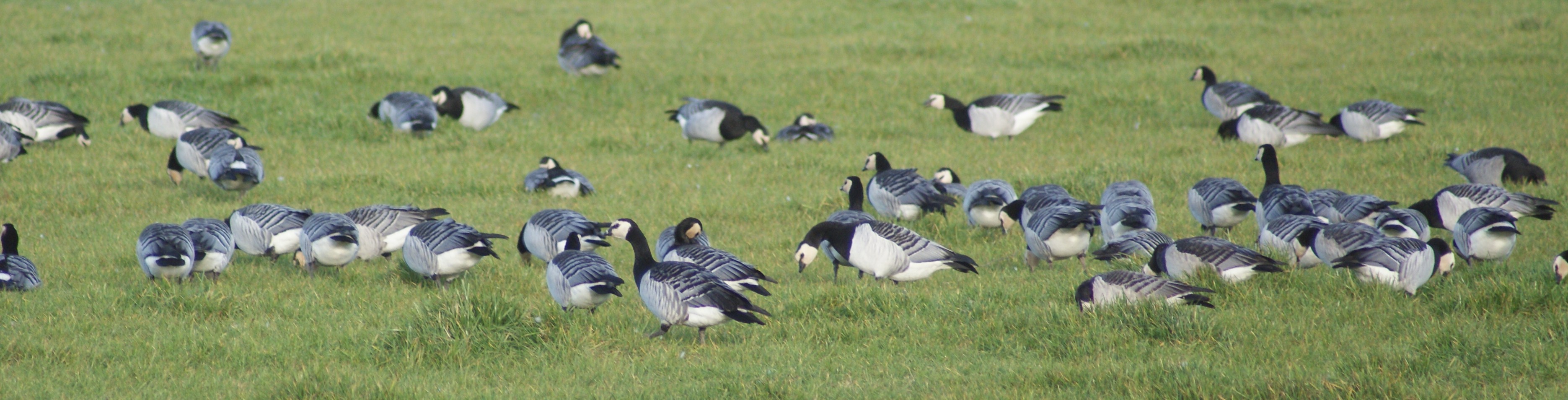
Once again, I find myself in the happy situation of being able to stick my oar in and have a say about a subject that doesn’t directly effect me. Listening in to Radio 4’s programme “saving species” yesterday morning, I heard an interesting report on conservation measures to ensure the ongoing prosperity of barnacle and greenland white fronted geese on the Isle of Islay.
Over the past few years, numbers of both species of geese have risen to amazing new levels on the island: in 1963, there were 8,000 barnacle geese and 3,000 greenland white fronted geese – today, the combined number of overwintering geese is more than 25,000. The massed birds do such damage to agriculture that farmers on Islay are receiving compensatory funding to ensure that they do nothing to disturb the protected species as they feed on the arable crops.
It is well known that greenland white fronted geese are an internationally threatened species, but barnacle geese have no such population difficulties. All along the Solway coast, massive random skeins of barnacles roam happily across the seaside fields, benefitting from a law brought in to protect them after their numbers were decimated after the second world war. It probably was a good idea to protect them when their numbers were dwindling, but now that they are thriving, that legal move is beginning to look a little silly. The obvious solution would be to save the farmer’s subsidy and allow barnacle geese to be shot again, but that very suggestion is naive.
The fact is that as soon as an animal is taken off the quarry species, it will never return to it. When the sport of shooting allows a single bird species to become protected, it not only demonstrates to the wider public that we can’t look after our own gamebirds, but also gives the appearance of the fact that we can do without the strong tradition of variety that runs through British sport.
Recent trends in shooting now focus on pheasants and red legged patridges as the only gamebirds. Other wild game species like golden plover, ptarmigan, black grouse and blue hares once played an important part in the sporting world, but the fact that they are difficult to manage and shoot on a large scale has seen them drop into partial obscurity. One by one, they are beginning to struggle, falling into the protected species lists as their habitats decay and are left unmanaged. All the while, sportsmen who should be mourning their absence look forward instead to shooting pheasants as if they were the only quarry species out there.A century ago, it was not unusual for a shooting party to take ten different species in a day. Nowadays, we are usually restricted to three or four; pheasant, partridge, woodcock and snipe.
We should be aware of the marginal quarry species and work towards resurrecting those various days of the nineteenth century. If we are not careful, we risk losing our right to shoot wild birds. They will fall into the management of conservation charities from the school of thought which regards “more” as “better”. There are clearly too many geese on Islay, and it is a natural accident waiting to happen. How much more reliably the situation could have been looked after if we hadn’t chased the barnacle goose off the quarry list.

 Bog Myrtle & Peat
Leave a comment