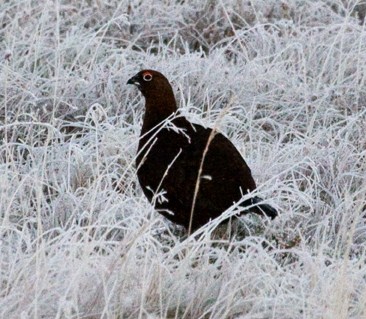
Dumfries and Galloway has never really been known for its grouse moors. In the golden days of upland sport at the turn of the last century, our hills produced thousands of blackcock, and visitors came up from England to cast a fly on our remote lochs, but we have simply never produced red grouse on a large scale. The habitat was there, but with a constant flow of sporting visitors determined to head north of the highland line, the investment was never really forthcoming. In the same way, remote corners of Wales showed equally fantastic but sadly unrealised potential, and all the vital money was pumped elsewhere.
And running a moor is a fabulously expensive business. Going up with some friends and colleagues to visit a recently reinvigorated grouse moor on the border between Galloway and Lanarkshire this afternoon, I was thrilled at the prospect of seeing moorland management in action. Much of the owner’s work over the past few years has centred on sowing heather seed, which is a rapidly developing science amongst grouse moor owners. By the judicious application of environmentally agreeable herbicides, timely burning and the liberal application of heather seed, work on the moor is gradually making a massive difference to the undergrowth on offer to the local birds.
We walked through a patch of rank molinia grass, which over the past few weeks has turned from green, to red, to gold. Bulbous blooms of sphagnum moss loomed in the shade, but aside from the occassional limb of cross leaved heather, that was it. As we passed on to the reseeded patch, the differences were obvious. Six or seven inch long strands of ling reared out of the moss, along with blaeberry, cotton grass and an assortment of tiny flowers. As if on cue, two grouse lifted out of the vegetation thirty yards ahead. With a mad cackle, they sped away into the sunlight.
Over the next twenty minutes, I listened to how the owner has tirelessly worked to regenerate the heather on his hills, and all the while his labrador worked the ground within seventy yards, flushing grouse to emphasise his master’s success. On two occassions, the cheerful dog flushed a blue hare, refusing to acknowledge that it had bitten off more than it could chew as it chased the ragged grey shape through the long grass, losing ground at every step.
We walked a circuitous route back to the car, and as I was towards the front of the group, I was the first to see one of the finest spectacles in the sporting world. Fifty yards away, an entire pack of red grouse poised themselves defiantly on a low bank of cotton grass. One or two birds were completely visible, standing proudly before us as if we were nothing more than midgies, while others poked their heads out from the tussocks and gazed passively in our direction. My utter joy at seeing such a huge pack of stunning birds was tempered by the fact that I had left my camera at home. If I had turned that moment into a photograph… if, if, if.
With a sweet purring sound, they rose into the air. Thirty birds rose out of the grass. It was more than I have ever seen in one place at the same time, and the sight was phenomenal. They curled around below us, swaying and gliding like shot spread from the barrel of a gun.
The moor is a tribute to the tremendous amount of work and thought put in by a team of dedicated grouse lovers over more than a decade, but simple labour is not singlehandedly responsible. You need deep pockets to see returns in the uplands, and if I was a rich man, I would do to the Chayne exactly what the owner has done to his land. If I was a rich man…

 Bog Myrtle & Peat
Leave a comment