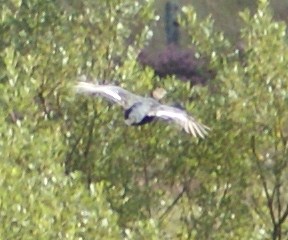
It has almost been two months since I last saw the blackcock. Despite the fact that reliable sources told me that I should expect him to vanish during his moult in July, I felt certain that he had been killed and eaten by some coarse and unwelcome predator. Finding his feathers in early July provided evidence for both possibilities, but the pessimist in me knew that the fantastic gentleman in black had fallen at last to the enemy.
I was trying not to think about it. This whole project is designed to benefit the moorland ecosystem, but without the blackcock’s hilariously arrogant and intrusive presence around the farm buildings, my plans had lost some of their enthusiasm. It takes some determination to break your back planting trees which will one day benefit a vague and ambiguous game species. My main source of inspiration and encouragement came from being able to stop work every half hour and see what the blackcock was up to. Watching him taunt the trapped crows in the larsen trap in June or cheering him on as he attacked pheasants in April gave the project a whole new dimension, so when I saw him again today after an absence of nearly two months, I was utterly delighted.
I had nipped up to the farm to inspect a patch of larch trees I planted in March, and as I parked the car, I spotted a dark figure lurking in a patch of heath rush high up on the hill above me. Exchanging my aged rover for a quad bike, I followed the path up to the trees, passing near by where I had seen the dark shape. With a tremendous clatter, the blackcock emerged like a typhoon, but what a changed spectacle!
When I last saw him, his wings were dusty brown and his tail fan was incomplete. Today, his wings were jet black and glossy blue and his tail had fallen off altogether. His new tail will come in with stunning curls by October and he will be a mature cock by the lek next spring. Most remarkable of all was the fact that his head had completely changed colour. The last time I saw him, feathers were falling off his chin and neck and I was told that the cock birds undergo a partial moult in late June, replacing black feathers on their heads with brown to camouflage them during the main moult in July and August when they cannot fly. When I saw him today, his head and neck were a rusty brown colour, with scruffy and overlapping feathers giving him an ugly appearance when compared to his immaculate black wings.
It is so exciting to see that he has made it through the dangerous days when his moult made him vulnerable to predators, and now I realise how important it is that I look after him and the others over the coming winter. My first concern is taking a hard line on foxes, picking up where I left off with the .243

 Bog Myrtle & Peat
Leave a comment