The RSPB really do care about black grouse, but I had to keep reminding myself of it when I drove out to Geltsdale on Sunday to look around their reserve in the hills overlooking Carlisle. When I was interviewing some volunteers at the RSPB stand at the Great Yorkshire Show in July, they proudly informed me that black grouse live side by side with raptors on their flagship propertyin Cumbria, and I decided that, if that were true, it would certainly be worth having a look.
Geltsdale was “saved” from grouse shooting when it was bought by the RSPB some time ago, but recent figures have shown terrible declines in all bird species since it started to be managed by Britain’s favourite conservation charity. The moor itself is swathed in heather, but the low ground where I walked on Sunday is of a different aspect altogether. Bracken forms a suitable habitat for black grouse during the summer months, but the sheer quantity of that plant on the low ground was utterly incredible. In several areas, birches and alders had been totally overgrown and killed by dense forests of ferns, and several young trees looked decidedly weak and ill, having been smothered by previous years of bracken growth.
The RSPB do control foxes and crows on the low areas of moorland where black grouse continue to struggle along, but the work is not being carried out with any great efficiency. I saw five crows within a hundred yards of the carpark, and a strong smell of fox wafted off several of the main paths. A neat string of stoat shit lay beneath a collapsed tangle of bracken, and it was fairly clear that vermin control has been largely neglected. It was surprising because since the RSPB are normally so staunchly opposed to vermin control, you might have thought that in the few places where they allow it to happen, they would at least ensure that it was being done efficiently.
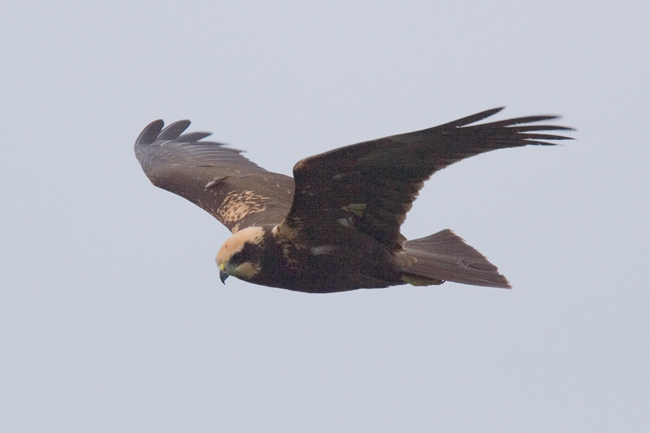
High up on the hillside, sparrowhawks and buzzards wheeled in the sky. I counted four raptor species in an hour, and while watching a barn owl was delighted to see my first marsh harrier circling low over an area of rushy bog. It clearly is an excellent place to be a raptor, and it was hardly surprising to see that black grouse numbers were recently described as being less than a third of those found on neighbouring estates. Throughout the whole day, including a two mile walk through the centre of the reserve, I saw:
6 carrion crows, 5 hawks, 2 buzzards, 1 marsh harrier, 1 barn owl, 1 dipper, 2 meadow pipits, 1 heron and a wagtail. I heard a curlew, but saw that it was actually calling from outwith the reserve. When compared to the hills around Teesdale, Geltsdale is utterly devoid of birds.
Researching the reserve, I also found that it is now home to a pair of breeding feral eagle owls. Although I didn’t see them, it made me laugh to learn that eagle owls frequently feed on hen harriers, and that it has been suggested that low densities of hen harriers at Geltsdale has been at least partially attributed to the presence of the owls. I wonder how the RSPB will react to the problem of raptors feeding on other raptors? I suspect that they will simply turn a blind eye, allowing what should be a stunning piece of moorland to become a barren wasteland.

 Bog Myrtle & Peat
Leave a comment