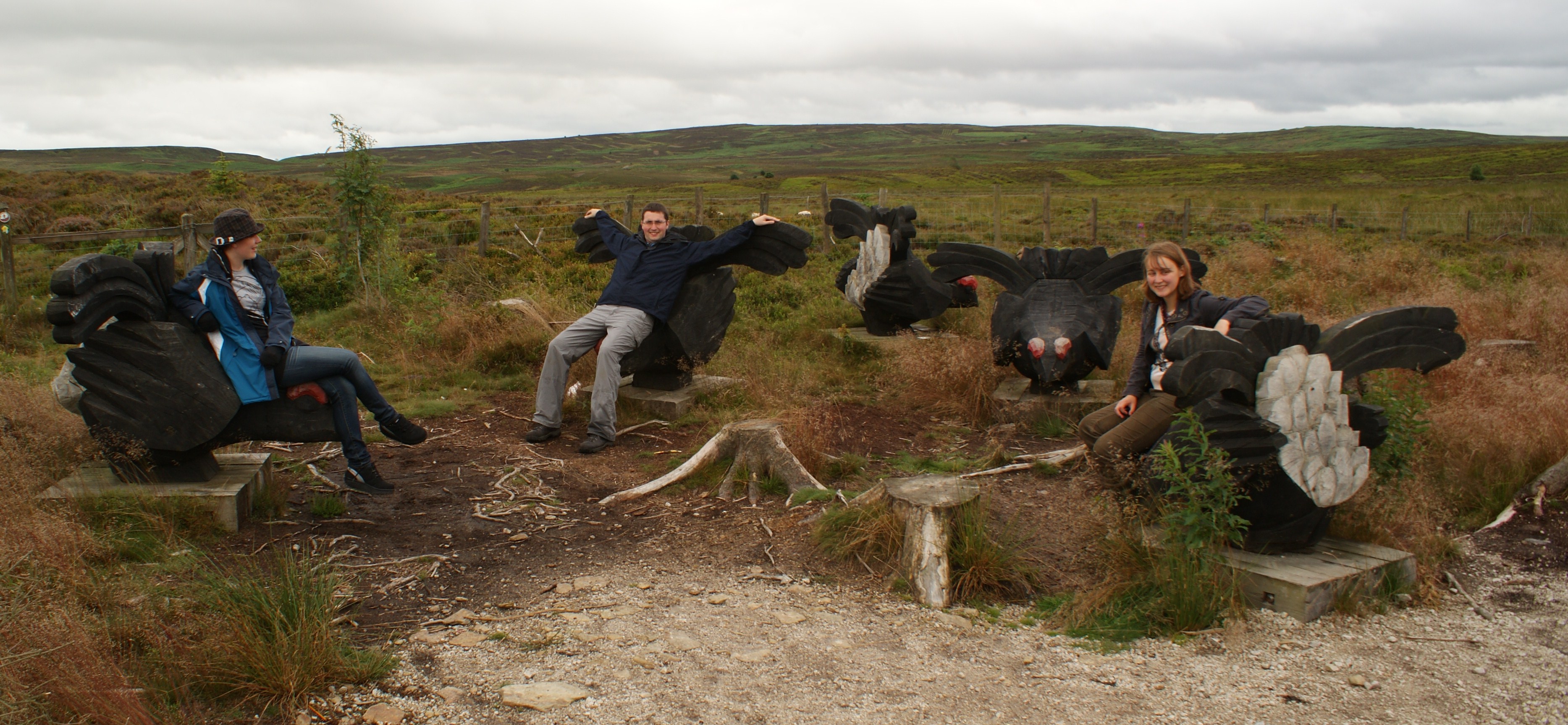
Returning from the CLA game fair on Saturday, I noticed a sign to North Wales above the motorway. Having heard that a few black grouse still survive in the Vale of Clwyd and feeling flush enough to afford the petrol, I decided to stop in and have a visit. Around half of Wales’s surviving black grouse population live in and around Coed Llandegla, a refurbished area of Forestry Commission land in the hills above Coedpoeth. Within an hour I had arrived.
The woodland is managed as a mountain biker’s paradise, and it has dozens of “routes” through the forest. I have no interest at all in mountain biking, and I found the spectacle of lycra clad cyclists more than a little amusing as they huffed and howled their way around the forest. I did wonder what effect a constant human presence must be having on the usually secretive and reclusive black grouse, but I suppose that in the days when they lived in and around farms across the uplands, they must have become used to dealing with people.
The forest at Coed Llandegla has been systematically felled and replanted to present black grouse with appropriate tree cover, much in the way described to me as typical of Welsh and southern Scottish black grouse habitats by Phil Warren at the GWCT. Tall spruces have been cleared and replanted with birches, and huge areas have resown themselves with young pines to varying heights of between six inches and three feet. Geometrically precise blocks have been felled and replanted, and while it’s not pretty, the heather and the blaeberry have been allowed to creep through the open areas. The forest is literally packed with food for black grouse.
Managed as part of a large partnership of RSPB-like trusts and funding bodies, it seems that little attention is given to vermin control, and corbie crows roared across the tree tops as we walked along the designated paths. As I made it to the furthest point of the “black grouse route” from the carpark, the forest opened suddenly onto clear moorland, stuffed with heather and blaeberry. There, a timber hide allows paying visitors to view the lek up close in April and May, and wheelchair access throughout means that, to my taste, the forest is unpleasantly sanitised and human. Signposts and routemarkers were found every few hundred yards, and the entire area is literally swamped with cyclists screeching and yelping in neon vests.
On a vaguely related note, it always amazes me how “outdoor wear” companies get away with selling lemon yellow jackets and neon orange hats. It amazes me even more that people are prepared to wear them. You can see a luminous hillwalker across three miles of open country, and they must never come across any wild animals at all. It takes a peculiar self-importance to deliberately choose clothing which makes you stand out from the countryside, and it is surely far nicer to wear a darker tone when you are out walking or cycling, if for no other reason than the fact that you wouldn’t look like litter.
Anyway, it was fascinating to see a whole new approach to black grouse management at first hand, but despite the fact that the forest specialises in attracting tourists, the entire set up was scarily commercial and unnatural. I wish the Welsh black grouse all the best, but I must say that I don’t envy them their home in Coed Llandegla.

 Bog Myrtle & Peat
Leave a comment