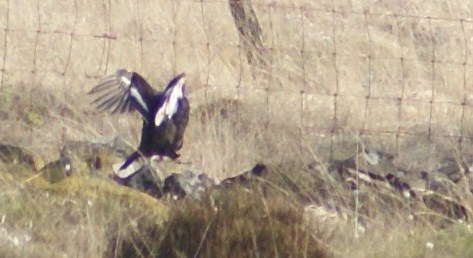
The black grouse and his greyhen seem to be doing very well in the bog by the farm buildings. I watched him this afternoon as he jumped back and forth off the foundations of a ruined stone wall a hundred yards away. In theory, the greyhen should be sitting on eggs by now and he must just be kicking his heels until the chicks appear. Not that he’ll have a hand in raising them anyway, but judging by his personality, he’ll try and claim all the credit. It’s almost impossible to relate how excited I am by the potential of chicks, but they will inevitably vanish into the beaks of crows and kites within a few hours. I am trying not to get my hopes up.
I recently got in touch with John Cowan, author of the controversial new book “Advice From a Gamekeeper”, in the hope that he could shed some light on helping grouse and black game. John has a great deal of experience with black grouse, and with a working experience on land around the Ettrick valley and Eskdalemuir during the 1980s, he must be one of a handful of people in the region who can really speak with authority on the subject. He was thrilled to hear that black grouse are still alive and well (although in seriously depleted numbers) in the Galloway hills, and he told me some very interesting things about management and keepering.
It may be necessary to put in a “sacrificial crop” of oats for the black grouse and his greyhen over the next couple of weeks, not only to keep the family fed up into the autumn, but also to stop the chicks from vanishing if they survive through the winter. Patches of sown oats are the traditional favourites of black grouse, and it could be that I can buy their loyalty to the Chayne by giving them a decent and reliable source of their favourite food.
As far as trees go, John was very helpful in offering advice. He recommended that I should plough an area for planting it so that the nutrients locked in the wet peat can be turned over and allowed to come into play. He remembers an enormous population explosion of black grouse in the Borders within a few years of a sheep farm being ploughed and planted. Blaeberry and heather went into overdrive, and even though new pine plantings quickly lose their nutritional value, there is no reason why thoughtful thinning after five or six years couldn’t prolong the productivity of the habitat.
It is always helpful to get a new perspective on the project, but when advice comes from such a knowledgeable and encouraging source, it gives everything a new energy.

 Bog Myrtle & Peat
Leave a comment