I have been worrying about my black grouse cock. If he didn’t have a female by his side, he was wasting his time by aimlessly lekking to himself. If he didn’t have a female, it would be a matter of time before he was killed by a fox and that would be the end of his story. Black grouse will lek whether or not they have a female, although the display is tinged with a degree of pathetic sadness, and I was beginning to think that this bird was a wandering soul, never destined to meet with true love.
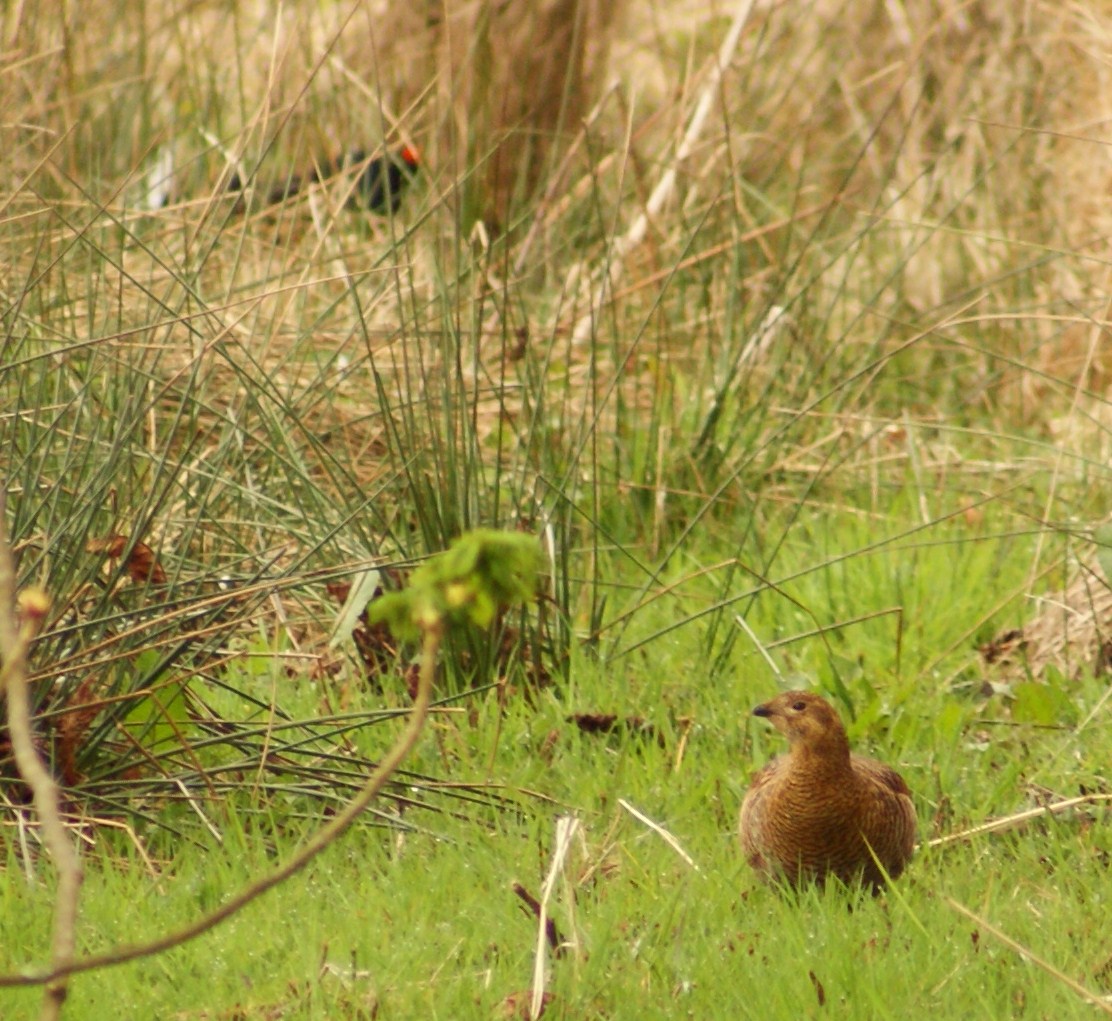
I was planting silver birches in the bog below the house yesterday when I heard him lekking. He seems to display at all hours at the moment, and as I crept up to him behind a dyke, I saw his swollen red wattle dancing through the long rushes. He was partially obscured by a fallen tree and a patch of dead grass, so I watched him for ten minutes, hoping he’d emerge for a photo call. After a little while, I noticed movement on the dyke behind him. Delicate feet appeared on a tumbled boulder, and then a greyhen stepped out into a little clearing.
The contrast between a blackcock and a greyhen is extraordinary. He is a swollen and immediately recogniseable bird with the habits and characteristics of a parrot while she creeps silently from cover to cover like a terrified mouse. Her intricate markings give her the appearance of something between a red grouse cock and a melanistic hen pheasant. The only thing that would properly identify her would be her long tail and muffled black beak, but you would need to take a close look to spot either.
So it seems that my blackcock has a wife, and the more time they spend around the house, the more likely it is that they will breed in the bog at the bottom of the lawn. Just a week ago, I wasn’t sure if there were any black grouse left on the Chayne at all. In seven days, I have found what is potentially a breeding pair just thirty yards from the farm buildings.
When I showed the shepherd the photographs of the greyhen, she was confused. Apparently, she has seen birds like that across the farm now and then, but had never been able to identify them. It could even be that there is more than one pair!

 Bog Myrtle & Peat
Leave a comment