The long woodcock strip now lies in three sections. Part has been opened up with a long ride and a series of clearings, part has been brashed to a height of six feet and the remaining two acres have not been touched by a chainsaw.
The ride and the series of clearings were designed to allow woodcock to carry out their “roding” flights through the trees, providing them with concealed launch pads to get in and out of the wood and also to encourage bird friendly undergrowth to come up from below. Spring is slow for plant life this year since we have had so little rain, but buds and shoots are beginning to show through, boding well for this area of the wood.
The untouched acre is currently home to a pair of woodpigeons and a pair of buzzards, although quite how happy that neighbourly relationship will ultimately be remains to be seen. It is hard to pass the strip just now without seeing the cock pigeon performing his fantastic aerial displays, and his undulating flight seems so full of bravado and arrogance that it always makes me smile. As he reaches the peak of his flightpath, he pats his wings together like a triumphant Spanish bullfighter, as if to say “This is so easy!”
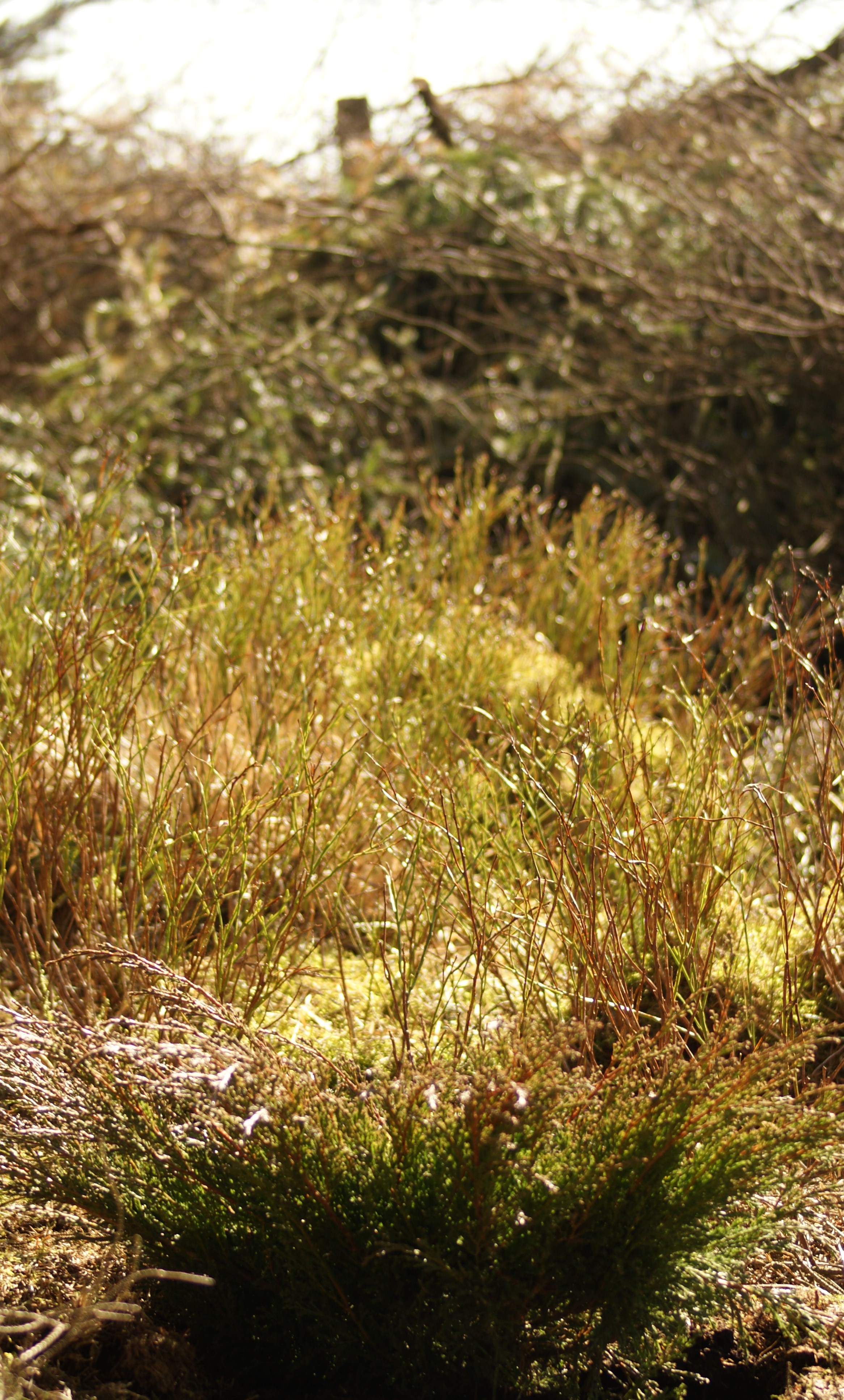
The area of the strip that was completely brashed is most interesting of all because of the sheer volume of blaeberry plants revealed by the chainsaw work. Already those long green strands are starting to bud and show signs of life, and I was thrilled to hear that the shepherd was doing her rounds for the lambs when she saw a “hellish big” grouse fly out from the heather nearby and land in the cover of the trees. Although it is entirely unconfirmed and it could have been any number of things, it could be that she saw a female black grouse using that strip – just three days ago!
Whatever it was, I am determined to encourage it (especially if it was indeed a black grouse), so I took a few Juniperus horizontalis youngstown plants out to the strip and planted them amongst the blaeberry. From what I can gather, “youngstown” is a low growing, shrubby plant which produces thousands of juniper berries and it should fit in well with the resident undergrowth. Like everything else on this project, I am now wishing that I had done all this work five years ago.
Better late than never, I suppose…

 Bog Myrtle & Peat
Leave a comment