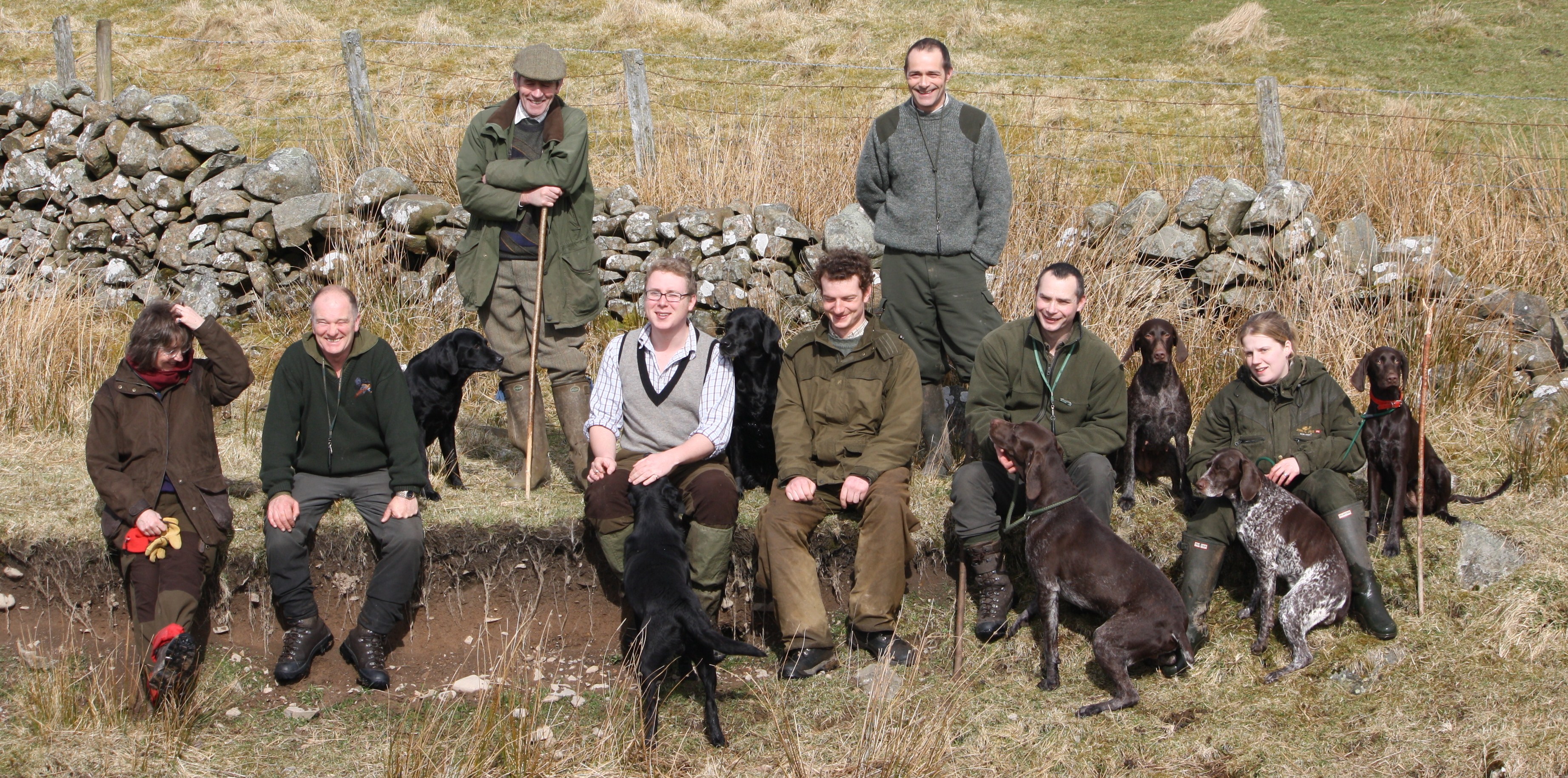
The grouse have paired up on the Chayne, and they’ll soon be beginning to nest. It is the perfect moment to conduct a count and work out precisely what territories are where on the farm, but not having the know-how or the resources to carry out the task on my own, I needed help.
I recently read an article in the sporting press about NOBs, the National Organisation for Beaters and pickers up, and I was interested to see that they are able to provide a link between people who need dogs and people who have dogs. A quick email later, and I was in touch with Graeme Hunter, the Scottish representative for the organisation. Graeme agreed to provide a team of experienced counters, and we duly set off to the farm this morning in convoy, none of us having the faintest idea what was ahead of us.
It was a cloudy morning, but as we pulled up by the gate burn, displaying snipe purred overhead and the skies began to clear. It rained heavily last night, and the puddled roads are now filled with vast blooms of frog spawn, coated in sediment and froth. When the car doors opened, four fantastic german shorthaired pointers poured out to mingle with the already confusing mixture of cocker spaniels and black labradors. It was game on.
In practice, grouse counting is surprisingly simple. Walking in a long straight line, each beater counts only the grouse he sees flushed by his dogs, and a total can be calculated from the tallies at the end of the day. Normally, a sample patch of moorland would be counted and a total for the entire property surmised on the basis of that count, but since the Chayne is so small and we have so few grouse, it was possible to cover the entire moor in a few sweeps.

We set off on to the hill with high hopes. Within five hundred yards, we had made first contact. A cock and two hens rippled up into the breeze with a fearless cackle and buzzed over the stone wall to the neighbouring property. It wasn’t clear whose dogs had put them up, but my blood was pumping and I was desperate to see more. Two hundred yards further and I reached a low rise just in time to look down on a pair of chocolate brown shapes as they coursed over the grass ahead, turning slightly in the wind and vibrating with blurry wingbeats.
As we walked, skylarks hung over us like tiny kites, trilling and setting their wings to hover in the air. Curlews and snipe lifted out of the sphagnum ditches to call and sink back down again with a flutter, and as we returned to the vehicles, a ragged window of sunshine raced up from behind to bring some stunning colour to the hillside. What had seemed like a potentially drab day had become a beautiful walk in the hills, and I now have a reasonably accurate idea of where my handful of breeding pairs are settling in to nest.
Bracing myself for the worst, I took the opportunity to quiz a few of the NOBs about what they thought of the grouse habitat on the farm. Having seen the property at first hand, their advice was more useful to me than any I have received so far, and they unanimously referred to a problem that I had never even considered before. If I am going to turn the moor around and return it to its glory days, I will have to confront the enormous problem of drainage.

 Bog Myrtle & Peat
Leave a comment