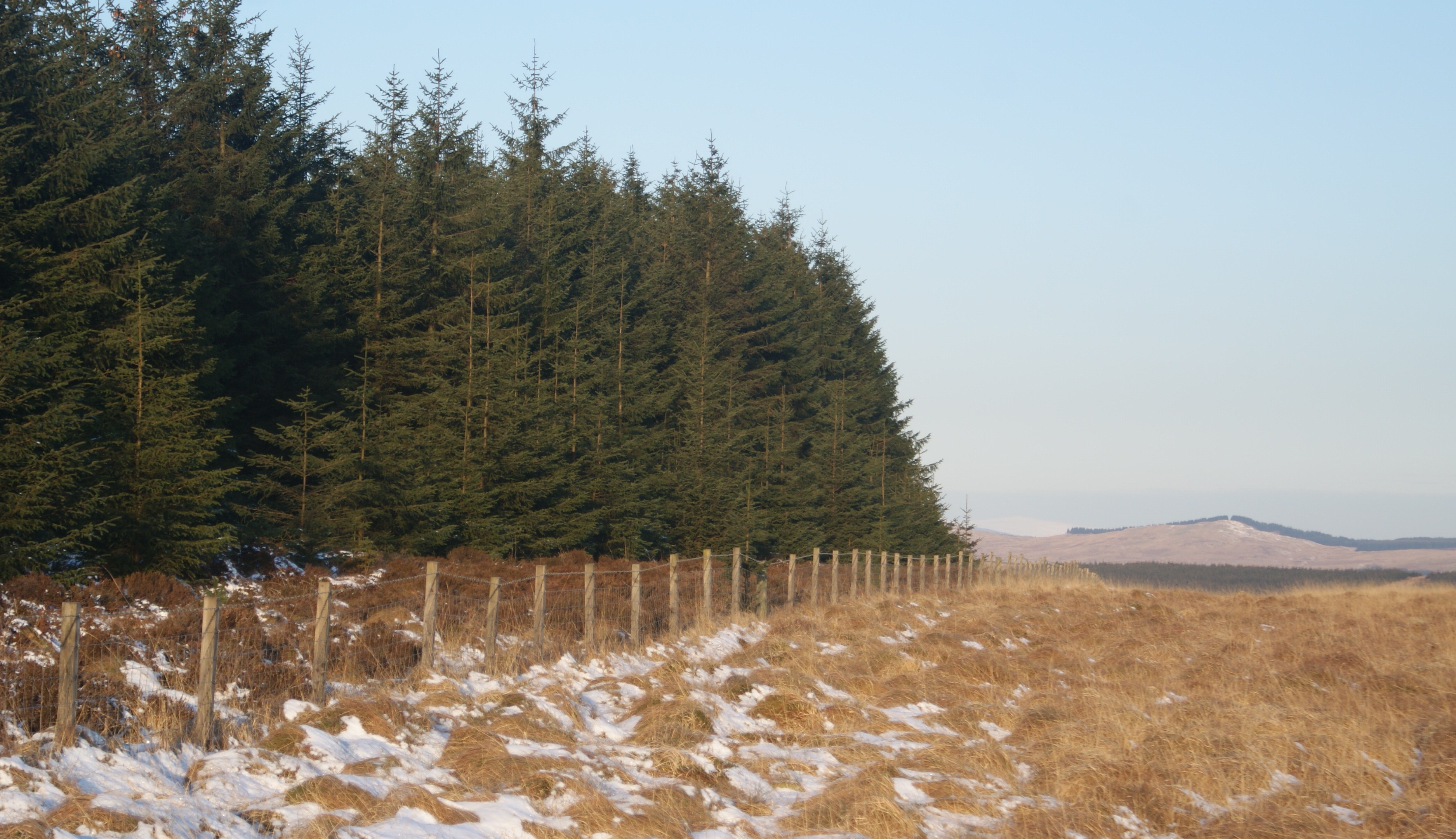
The time is fast approaching to fence off my juniper stand. The spring is coming in and the time for planting will soon be upon us. Ever since the idea was first presented to me to plant a new spinney, I always planned to site it on the spot where the last black grouse was seen, two miles into the farm behind a miniature range of rounded hills. On second thoughts, I think I have had a better idea.
A blackgrouse territory is comprised of a number of different elements. Being marginal birds, they choose to live on the fringes of forests where the trees peter into moorland and open heath. They enjoy the best of both worlds by feeding not only on heather but also on tree buds and berries which are off limits to their red cousins. Over the past sixty years, Scotland has been heavily forested by government agencies determined initially to keep Britain self sufficient in its supply of timber. The scheme never really succeeded, and now many of the nation’s uplands are coated in ugly and lifeless blocks of conifers. Many are still being planted to be operated by absent landowners for the tax bonuses of a subsidised industry, and much of the wood is of such poor quality that it can only be used for pulp anyway.
Despite destroying thousands of acres of moorland habitat, forestry plantations did have some benefits for black grouse, and young stands of pine trees can be fruitful sites for breeding birds. However, as the trees grow, the quality habitat shrinks and the ‘margin’ between forest and open country soon becomes a narrow strip between bough and fenceline. The quality of the habitat remains,but it is now in such small quantities that the birds on the Chayne must have an enormous range, foraging across literally miles of narrow margin around the farm.
On an investigative foray around the farm’s boundary, I found an unusually wide strip of forest margin where heather and bilberry have been allowed to riot, safe from the hungry eyes of livestock. Self sown pine trees are scattered in the space, and it looks absolutely perfect for black grouse. The undergrowth on the Chayne in this area is spotted with strands of cross leaved heather and ling and there is no reason why, with the judicious addition of a juniper spinney here, the birds couldn’t be attracted over during the course of the next few years.

 Bog Myrtle & Peat
Leave a comment